Kiran Shah: The Entrepreneur Reimagining India’s Ice Cream Market With Go Zero
Kiran Shah, founder of Go Zero, has transformed his experience at P&G and Apsara Ice Creams into a fast-growing zero-sugar ice cream brand.

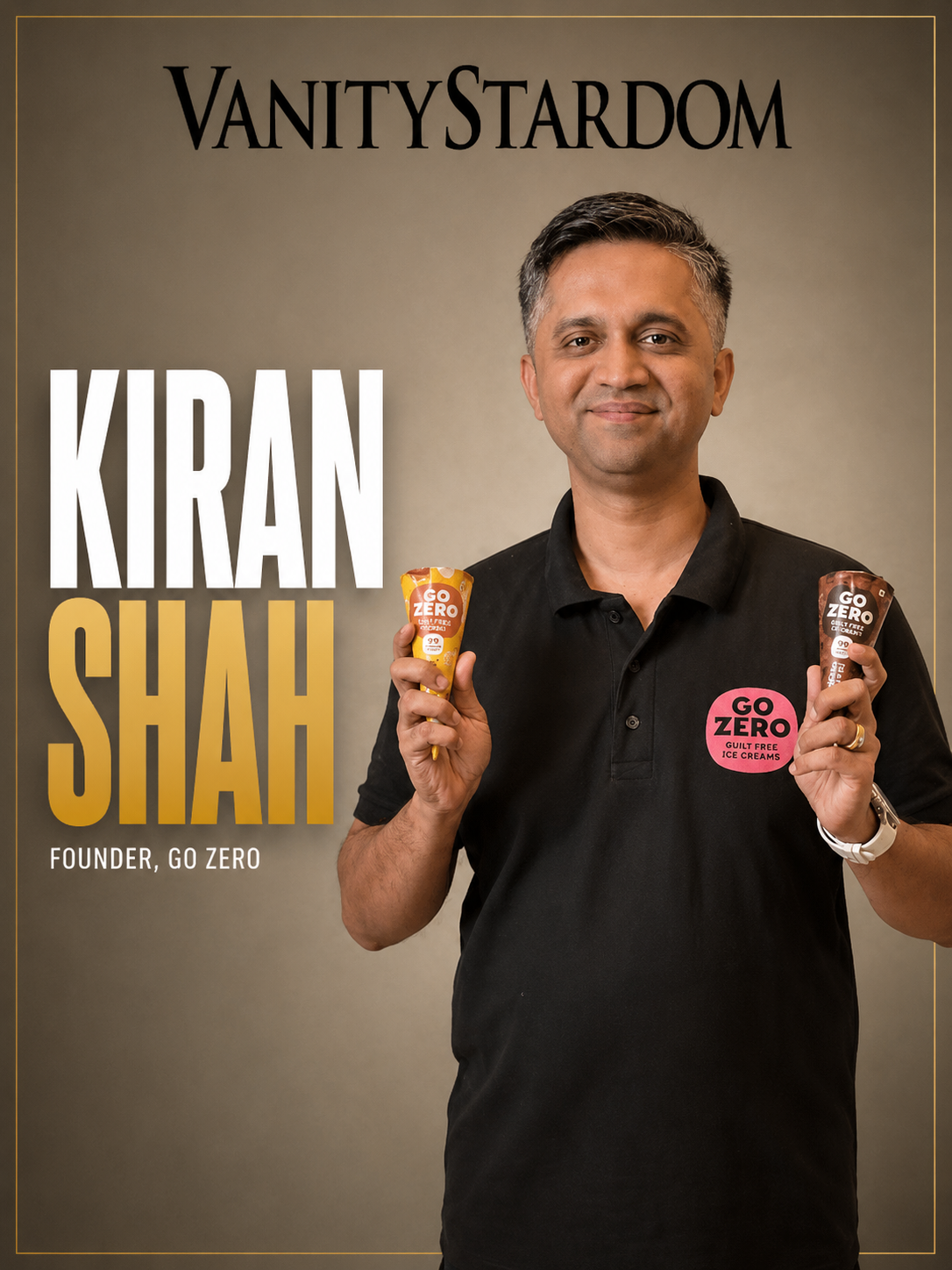
For Kiran Shah, entrepreneurship has been less about following a conventional career path and more about identifying where consumer habits are changing and building a business around that shift. The founder of Go Zero, a zero-sugar ice cream brand, has combined experience in global FMCG marketing, family-business operations and startup building to create a company focused on changing how consumers think about indulgence.
Shah’s professional journey began after completing his MBA from IIM Lucknow in 2011. He subsequently joined Procter & Gamble in Singapore, where he worked on established consumer brands and gained experience in marketing, brand management and consumer insights. His time at P&G exposed him to the processes behind some of the world's major FMCG brands, experience that later influenced his approach to building businesses.
After his corporate stint, Shah returned to Mumbai and joined his family's ice cream business, Apsara Ice Creams. The company had operated as a single-store business for decades before Shah became involved in its expansion. During his tenure from 2014 to 2022, he helped scale Apsara from its original single-store operation to more than 100 outlets across India, according to DSG Consumer Partners.
The experience gave Shah a close understanding of the Indian ice cream consumer, but it also eventually led him to a different business idea. During the pandemic, he began thinking about the relationship between people's love for desserts and growing awareness around sugar consumption. Go Zero emerged from that gap: an attempt to create an ice cream experience that could offer indulgence without the conventional sugar load.
The idea for Go Zero came to Shah in August 2021. After spending several months considering whether to leave the family business, he registered the new company in November that year. Following product experimentation and work on packaging and the go-to-market strategy, Go Zero launched in Mumbai on July 9, 2022. Shah has described the decision to leave a business he had helped scale and start again from scratch as one of the toughest decisions of his career.
The company's proposition was built around what Shah describes as better-for-you indulgence. Go Zero developed products using alternatives to conventional sugar, including stevia, FOS and maltitol. The company's proprietary sweetener blend, branded as Sweet Zero, was developed with the objective of reducing calories while retaining the taste and texture associated with conventional ice cream.
Rather than positioning the product simply as a dietary substitute, Shah's approach has been to build Go Zero as a consumer brand. Its portfolio includes zero-sugar, low-calorie and high-protein products, with the company focusing on making the health-oriented proposition compatible with the emotional appeal of ice cream. DSG Consumer Partners describes Go Zero as a better-for-you ice cream brand founded by Shah, with products built around zero sugar, high protein and lower calories.
The early months, however, were far from straightforward. Go Zero entered the market in July, during the monsoon season, when ice cream demand is traditionally weaker in many parts of India. Shah has recalled that the company generated almost no revenue during its first three months. Instead of abandoning the idea, the team used the period to build distribution and waited for the summer demand cycle to demonstrate whether the product could scale.
That strategy eventually began to produce results. Quick commerce became an important part of Go Zero's growth model, allowing the brand to reach consumers through platforms such as Blinkit, Instamart and Zepto. Shah has said that much of Go Zero's growth was built around quick commerce, an approach that allowed the brand to reach consumers without relying exclusively on traditional retail expansion.
Investor interest followed the company's early traction. Go Zero raised $1.5 million in a pre-Series A round in 2024, according to IIM Lucknow's annual report. The round was part of the company's broader effort to expand operations and strengthen its presence in the growing better-for-you food category.
In March 2025, Go Zero raised another ₹30 crore in Series A funding. Existing investors DSG Consumer Partners, Saama Capital and V3 Ventures participated, while Aman Gupta and Namita Thapar also joined the round. The company said the capital would be used for supply-chain expansion, product innovation and brand growth, particularly across Tier I and Tier II cities through quick-commerce channels.
For Shah, the significance of the fundraising has extended beyond the capital itself. He has emphasized the importance of existing investors continuing to back the business, viewing repeated participation as an indication of confidence in the company's direction. In his own account of the Series A round, he also noted that the company had retained more than half of the funds from its previous round when it raised the next round.
Go Zero's growth has also been accompanied by a shift in the scale of Shah's responsibilities. Moving from the hands-on operational environment of a family retail business to a venture-backed consumer startup has meant dealing with investors, leadership, distribution, product development and a rapidly changing digital commerce environment.
His earlier experience at P&G remains another part of that evolution. Shah has reflected that the corporate experience did not provide a direct blueprint for building Go Zero, but it taught him how to structure problems, work with consumer insights and understand how established brands build trust. His experience with Apsara, meanwhile, gave him a different lesson: that consumers do not simply buy products, but often respond to the story, trust and connection surrounding a brand.
That philosophy has become increasingly visible in Shah's approach to marketing. In July 2026, he announced that Go Zero would stop spending on paid influencer collaborations and instead use the budget to build an internal content-creation team. Shah said the company had been running around 30 influencer collaborations simultaneously but found it difficult to measure the return on that spending.
The decision reflects a broader attempt to build Go Zero's own voice rather than depending entirely on rented audiences. It also illustrates how Shah's role has evolved from product and distribution to a wider focus on brand-building and long-term consumer relationships.
The company's financial trajectory has meanwhile accelerated. In June 2026, Mint reported that Go Zero had recorded ₹35 crore in net revenue in May, representing 350% growth and its highest monthly net revenue at that point. More recently, Go Zero said it crossed ₹100 crore in net revenue in FY26, while Shah has stated that the company has grown beyond the scale of the family business he once helped build.
The contrast between those two chapters is central to Shah's entrepreneurial story. At Apsara, he inherited an established business and focused on scaling it. With Go Zero, he walked away from that familiarity and attempted to create a new category around changing consumer preferences.
The result is a business operating at the intersection of food, health-conscious consumption, premiumisation and quick commerce. Go Zero is now available across multiple Indian cities, with its product range and distribution expanding alongside the company's ambitions.
Shah's journey also offers a different perspective on entrepreneurship. His story did not begin with a startup straight out of business school. It moved from a global FMCG company to a family-owned retail business and eventually to a venture-backed consumer startup. Each stage brought a different kind of learning: structured marketing at P&G, operational execution at Apsara and experimentation, fundraising and category creation at Go Zero.
Today, Kiran Shah's work with Go Zero represents an effort to make healthier indulgence commercially viable at scale. The company's growth suggests that Indian consumers are increasingly willing to experiment with premium products that combine convenience, taste and health-oriented positioning. For Shah, the larger opportunity appears to lie beyond simply selling a different kind of ice cream: it is about building a consumer brand around the idea that indulgence and conscious consumption do not necessarily have to be opposites.
As Go Zero continues expanding, Shah's next challenge will be to maintain that balance while moving from a fast-growing challenger brand toward a much larger mainstream consumer business. His journey from P&G Singapore to Apsara and finally to Go Zero shows a consistent willingness to change direction when he sees a stronger opportunity—and to start again when the opportunity demands it.
Written by
Vanity Stardom is a global digital publication, founded in 2020, featuring entrepreneurs, healthcare leaders, founders, creators and institutions.