Adv. Mandeep Baisla: Where Law Meets Purpose

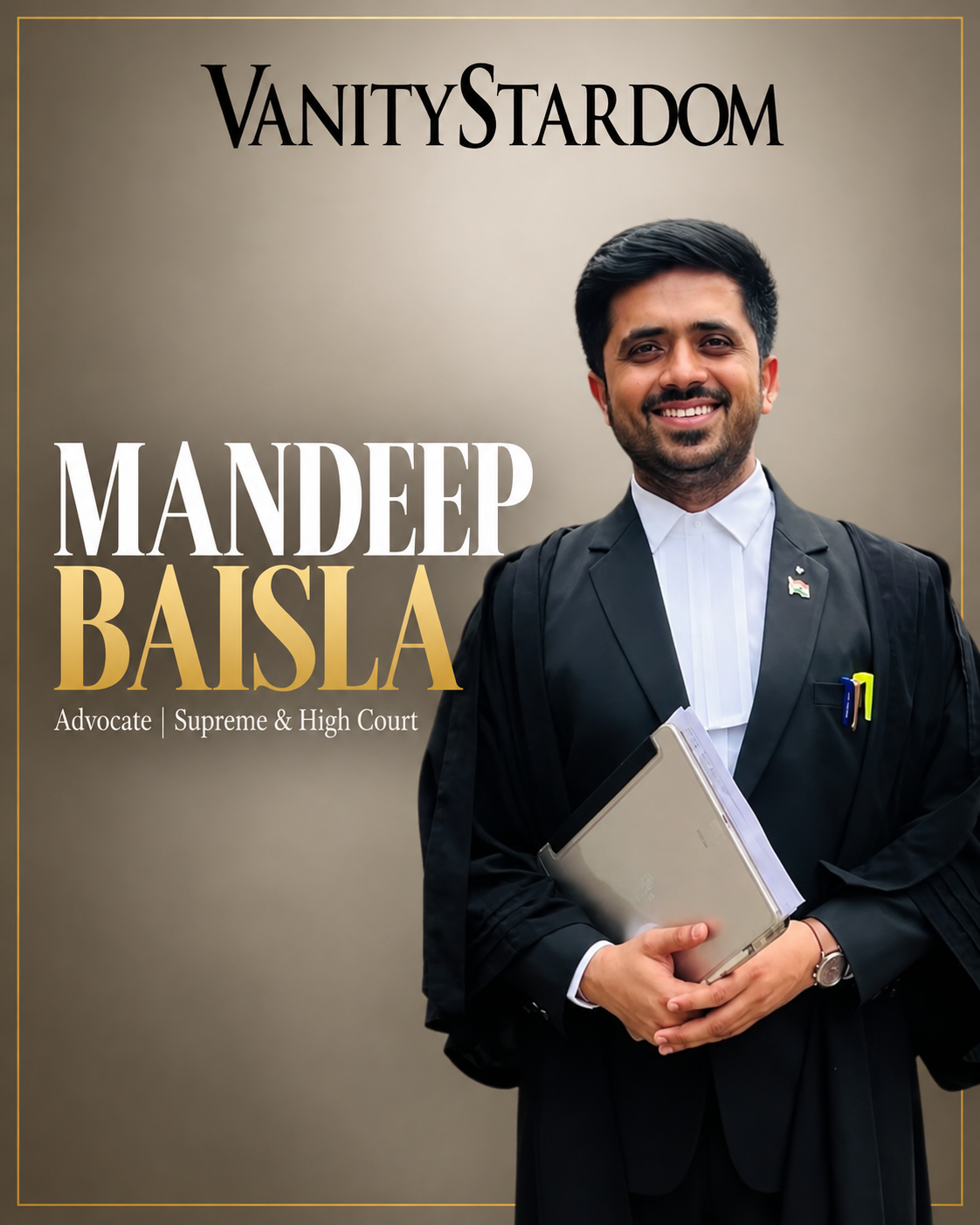
For many people, becoming a lawyer is the fulfilment of a professional ambition. For Adv. Mandeep Baisla, the journey appears to have become something more meaningful with time. His career in law has been shaped not only by his work in courtrooms, but also by a desire to understand the profession deeply and share that understanding with those who are preparing to enter it.
Practising before the Supreme Court of India and various High Courts, Baisla has built his professional journey around litigation, legal knowledge and continuous learning. But what makes his story particularly interesting is the connection he has developed with law students and young advocates. Through conversations, mentoring, academic interactions and professional guidance, he has increasingly become a familiar voice for those trying to understand what it really means to build a career in law.
His own academic journey began with Political Science at Kirori Mal College, University of Delhi, followed by his LL.B. from the Faculty of Law, University of Delhi. His early professional experiences included an internship with the Ministry of Petroleum and Natural Gas, Government of India, followed by work as a junior associate. These experiences gave him an opportunity to observe the legal profession from different perspectives before moving deeper into litigation.
The transition from studying law to actually practising it is rarely simple. The courtroom introduces a young lawyer to a completely different environment, one where theoretical knowledge has to be converted into practical understanding. Court procedure, drafting, preparation, client communication and the ability to respond under pressure are skills that develop over years of experience. Baisla’s professional journey reflects that gradual process of learning and building confidence through practice.
Over time, his work has extended beyond appearing in court. He has actively interacted with students and participated in academic programmes, moot court activities and legal-awareness initiatives. For young people considering a career in law, such interactions can offer something that textbooks cannot always provide: a realistic understanding of the profession.
That connection with the younger generation is one of the more distinctive aspects of Baisla’s public professional identity. Rather than presenting the legal profession simply as a collection of degrees and designations, he has spoken about the importance of understanding its practical realities. Litigation demands patience, discipline and consistency. There is no substitute for preparation, and professional credibility is built gradually through experience.
His involvement with legal education has also brought him into conversations around issues that extend beyond conventional courtroom practice. In 2024, Baisla participated in a seminar at Deshbandhu College, University of Delhi, focusing on women’s legal rights against workplace harassment under the POSH framework. Such programmes highlight the role practising lawyers can play in making legal knowledge more accessible to students and the wider community.
For Baisla, this educational side of the profession complements his courtroom practice. A lawyer deals with people at some of the most difficult moments of their lives. Behind every case is an individual, family, organisation or institution looking for clarity and representation. Understanding the law therefore requires more than knowing statutes and judgments. It requires the ability to understand people, their circumstances and the consequences of legal decisions.
His continuing presence in court has given him the practical experience that informs this broader approach. Court records show his appearances in proceedings before the Supreme Court as well as matters before the Delhi High Court. His practice has exposed him to different aspects of litigation and the procedural discipline required to represent clients effectively.
Yet the most valuable part of a legal career is often not visible in a cause list. It is the knowledge accumulated through years of preparation, the lessons learnt from difficult matters and the professional judgement that develops with experience. For younger lawyers, learning how to approach these challenges can sometimes be as important as learning the law itself.
This is where mentorship becomes significant.
The legal profession can be particularly demanding for those at the beginning of their careers. Many young advocates enter the profession with enthusiasm but little understanding of how long it can take to establish themselves. The initial years require persistence. There are long hours of preparation, court appearances, research, drafting and continuous learning. Success is rarely immediate, and the ability to remain committed during those early years can make a substantial difference.
Baisla’s engagement with students and aspiring lawyers reflects an understanding of this reality. His professional interactions have often focused on the practical side of legal careers and the importance of developing skills that remain relevant throughout an advocate’s journey.
In many ways, his approach represents a changing legal profession. Today’s lawyers are not defined only by their courtroom appearances. Digital platforms, academic programmes, professional networks and public legal-awareness initiatives have created new ways for advocates to communicate their knowledge. This has also created an opportunity for experienced practitioners to guide a generation that is entering a rapidly changing profession.
At the same time, the fundamentals remain unchanged. A lawyer still needs strong preparation, sound judgement, ethical conduct and respect for the profession. Technology may change the way legal information is accessed, but it cannot replace the responsibility that comes with representing another person’s interests.
That balance between adapting to change and respecting the fundamentals of the profession is an important part of Baisla’s journey. His work demonstrates how courtroom practice can exist alongside education, mentorship and public engagement without losing sight of the core responsibilities of advocacy.
There is also a larger lesson in his story. Professional success is often presented through visible milestones, but a meaningful career is built through many less visible moments. The hours spent researching a case, preparing a draft, listening to a senior, helping a client understand a difficult situation or guiding a student can all become part of a lawyer’s larger contribution.
For Baisla, the courtroom remains central to his identity as an advocate. At the same time, his interactions with students and young professionals suggest that he sees value in passing knowledge forward. That willingness to engage with the next generation adds another layer to his professional journey.
The future of the legal profession will require advocates who understand both the law and the changing world around it. New technologies, evolving regulations, emerging areas of practice and increasingly informed clients are changing the expectations placed on lawyers. Young advocates will need not only legal knowledge but also adaptability, communication skills and the confidence to keep learning throughout their careers.
Adv. Mandeep Baisla’s journey reflects that philosophy. His story is not simply about practising law or appearing before higher courts. It is about the process of becoming better at the profession while helping others understand it along the way.
Ultimately, the influence of a lawyer cannot always be measured by the number of cases handled or appearances made. Sometimes it is reflected in the confidence given to a young student, the guidance offered to an aspiring advocate or the clarity provided to someone trying to understand their legal rights.
That is what gives Baisla’s journey its wider relevance. His career represents the courtroom, but it also represents learning, sharing and the belief that professional knowledge becomes more valuable when it is passed on.
In a profession built on knowledge, experience and responsibility, perhaps that is one of the most enduring forms of success.
Written by
Vanity Stardom is a global digital publication, founded in 2020, featuring entrepreneurs, healthcare leaders, founders, creators and institutions.