BUSINESS
Gaurav Mehta: The Jaipur Entrepreneur Who Turned a Love for History Into a New Language of Indian Watchmaking

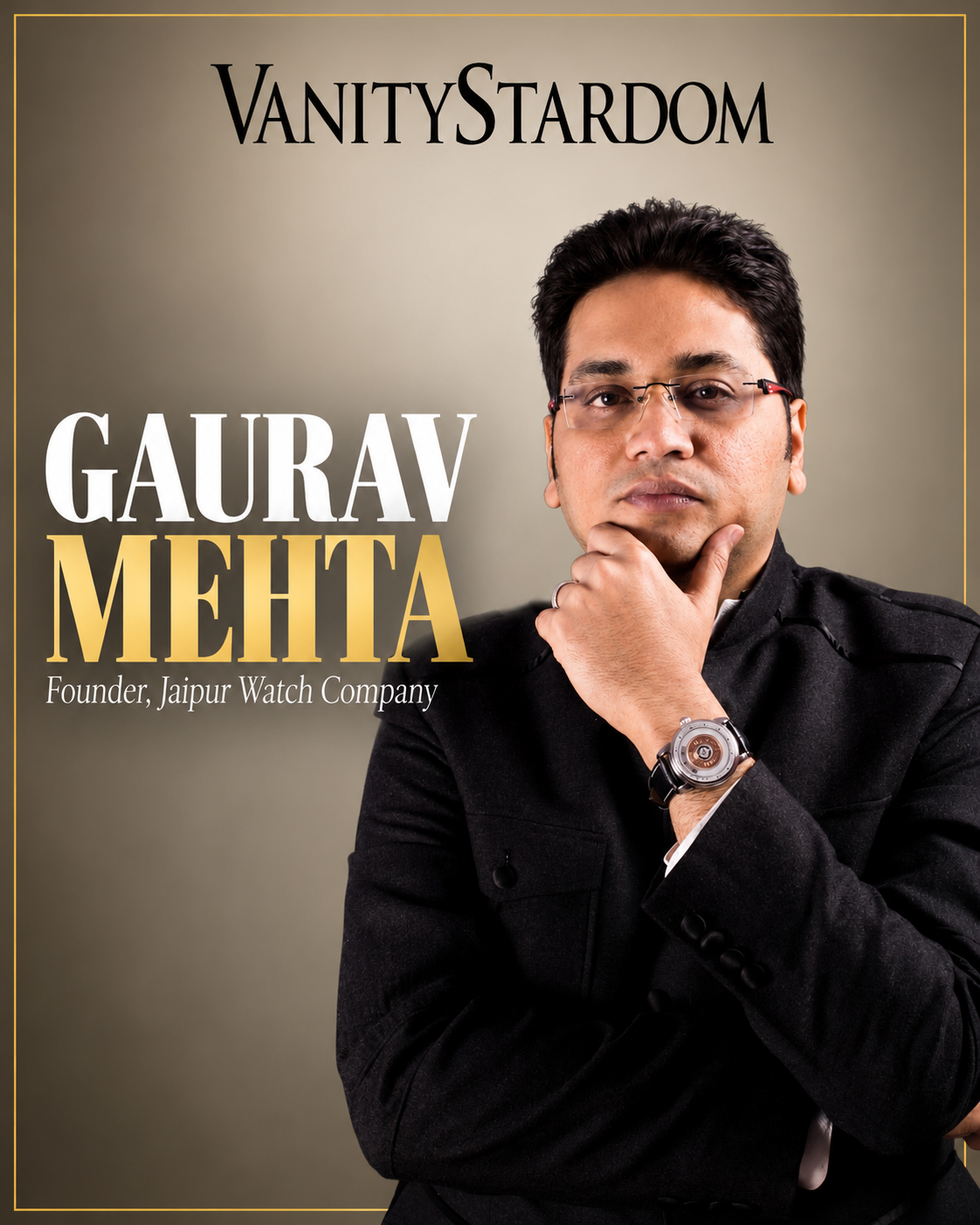
There are businesses that begin with a market opportunity, and then there are businesses that begin with curiosity. Jaipur Watch Company belongs to the second category. At the heart of its story is Gaurav Mehta, a Jaipur entrepreneur whose fascination with watches, old coins and Indian history gradually evolved into one of India’s most distinctive homegrown luxury watch brands.
Mehta’s relationship with watches started long before he thought of himself as a watchmaker. As a child, he was fascinated by how things worked. Watches became particularly interesting because they could be opened, examined and, eventually, put back together. At the same time, he developed a passion for collecting historic coins and stamps. What initially appeared to be two separate interests eventually came together in an idea that would define his career.
While experimenting with a watch, Mehta placed an old coin inside the dial. The result was unusual enough to attract attention from the people around him. That simple experiment became the inspiration for what would eventually become Jaipur Watch Company. The brand was formally established in 2013, built around the idea that a watch could do more than tell time. It could carry a piece of history with it.
The idea sounds obvious today, but when Mehta began, India’s luxury watch market was dominated by international names and conventional approaches to design. There was little established space for an independent Indian brand telling stories through its own cultural lens. Mehta decided to take that risk anyway.
His early journey was anything but easy. According to accounts of the company’s beginnings, he invested around ₹30 lakh after selling his BMW to finance the first production run. The decision was not simply a financial commitment. It was a personal bet on an idea that had not yet found a market.
The first watches were met with plenty of hesitation. Retailers were not immediately convinced that consumers would pay a premium for a watch built around an old coin. That resistance could easily have ended the experiment. Instead, Mehta kept refining the product and searching for customers who understood what he was trying to create.
That persistence eventually became one of the defining characteristics of his entrepreneurial journey.
Jaipur Watch Company was never intended to simply imitate the established luxury watch industry. Its identity developed around Indian stories, symbols, craftsmanship and aesthetics. Historic coins became one of its earliest signatures, but the brand gradually expanded its creative vocabulary to include stamps, art, architecture, mythology and other elements of India’s cultural heritage.
For Mehta, Jaipur itself became an important part of that identity. The city’s architecture, colours, royal history, craftsmanship and relationship with antiques provided an almost endless source of inspiration. Rather than treating heritage as something belonging only in museums, he began exploring how it could be interpreted through objects people could wear every day.
That philosophy helped Jaipur Watch Company occupy a space that was still relatively unexplored in India. The company describes itself as India’s first bespoke watch company and has built its reputation around limited-edition, handcrafted timepieces that combine traditional Indian influences with contemporary design.
There was another important element to Mehta’s approach. He did not want the Indian identity of his watches to come across as a compromise. The ambition was to create products that could stand on their own in the luxury market while still being unmistakably Indian.
That ambition became particularly visible as the company developed from its early coin watches into a broader watchmaking operation. By 2019, Business Standard reported that Jaipur Watch Company was selling around 900 bespoke timepieces a year and had developed its own cases, dials and crowns.
The brand’s appearance on Shark Tank India brought another wave of attention. Mehta’s experience on the show did not result in the conventional success story of receiving an investment, but the exposure proved valuable. He later said the episode helped generate significant attention for the company and encouraged the team to accelerate its retail expansion. The brand subsequently opened stores including locations at Select Citywalk in Delhi and Taj Rambagh Palace in Jaipur.
The episode also demonstrated something important about Mehta’s approach to rejection. Instead of allowing an unfavourable outcome to define the business, he treated the feedback as information. The company continued expanding, refining its products and building a stronger connection with consumers.
That ability to keep moving has become particularly relevant as Jaipur Watch Company has entered a more ambitious phase.
In 2026, the company introduced the first collection carrying Mehta’s own name, Gaurav Mehta Jaipur. Launched at the Chamber of Princes at Rambagh Palace, the collection introduced two major lines, Premium Baagh and Gates of India. The collection represents an evolution of the brand’s established design language while giving Mehta greater room to explore more elaborate forms of mechanical watchmaking.
Premium Baagh builds on the tiger motif that has become closely associated with Jaipur Watch Company, while Gates of India draws inspiration from India’s architectural heritage. Rather than simply placing a historic image on a dial, the new designs attempt to turn Indian stories and visual motifs into the structure of the watch itself.
That progression is significant because it shows how Mehta’s original idea has matured. The early coin watch was born from curiosity and experimentation. The newer collections reflect a much more developed understanding of design, craftsmanship and the possibilities of horology.
Mehta has also described the creative philosophy behind Premium Baagh as deeply personal. For several years, he was the company’s sole designer, and he has spoken about the collection as an expression of his own worldview. The new line therefore represents not only another commercial collection but a more direct expression of the person who has shaped Jaipur Watch Company’s identity from the beginning.
The company’s growth has also expanded beyond its original Jaipur base. In July 2026, Mehta said Jaipur Watch Company had 15 stores and was moving towards 19, with plans for international stores in Dubai and Sri Lanka. He also spoke about an ambitious longer-term target of reaching 100 stores.
Yet numbers alone do not explain the appeal of Mehta’s story.
What makes his journey compelling is the fact that he did not begin with a traditional watchmaking background. His entry into horology came through curiosity, experimentation and a fascination with objects that carried stories. He was not trying to become another Swiss watchmaker. He was trying to understand what an Indian watch brand could look and feel like if it started from India’s own history.
That distinction has become increasingly relevant as Indian luxury brands have gained confidence in presenting their heritage to a global audience. For years, luxury in India was often associated with imported names and international aesthetics. Jaipur Watch Company represents another possibility: that Indian craftsmanship, history and storytelling can themselves form the foundation of a premium global brand.
Mehta’s journey also offers a reminder that originality often begins before there is a market for it. When Jaipur Watch Company started, the category of Indian micro-luxury watches was barely established. Today, the brand describes itself as India’s first micro-luxury watch brand, and its evolution has made it a recognised name in the country’s independent watchmaking space.
Perhaps that is the most interesting part of Gaurav Mehta’s story. He did not simply build a company around watches. He built a company around the belief that timepieces could preserve memories, celebrate heritage and start conversations.
From an old coin placed inside a watch to collections inspired by tigers and India’s iconic architecture, the journey has remained remarkably consistent at its core. The objects have become more sophisticated, the business has become larger and the ambitions have become more international, but the original instinct remains the same: to create something that feels distinctly Indian without asking the world to see it as anything less than luxury.
For Gaurav Mehta, watchmaking has never been only about measuring time. It has been about giving history another way to live.
And in a market where many brands compete for attention by looking increasingly similar, that sense of identity may be Jaipur Watch Company’s most valuable creation.
