BUSINESS
Prateek Rathee Is Building a New-Age Real Estate Business Around How People Want to Live

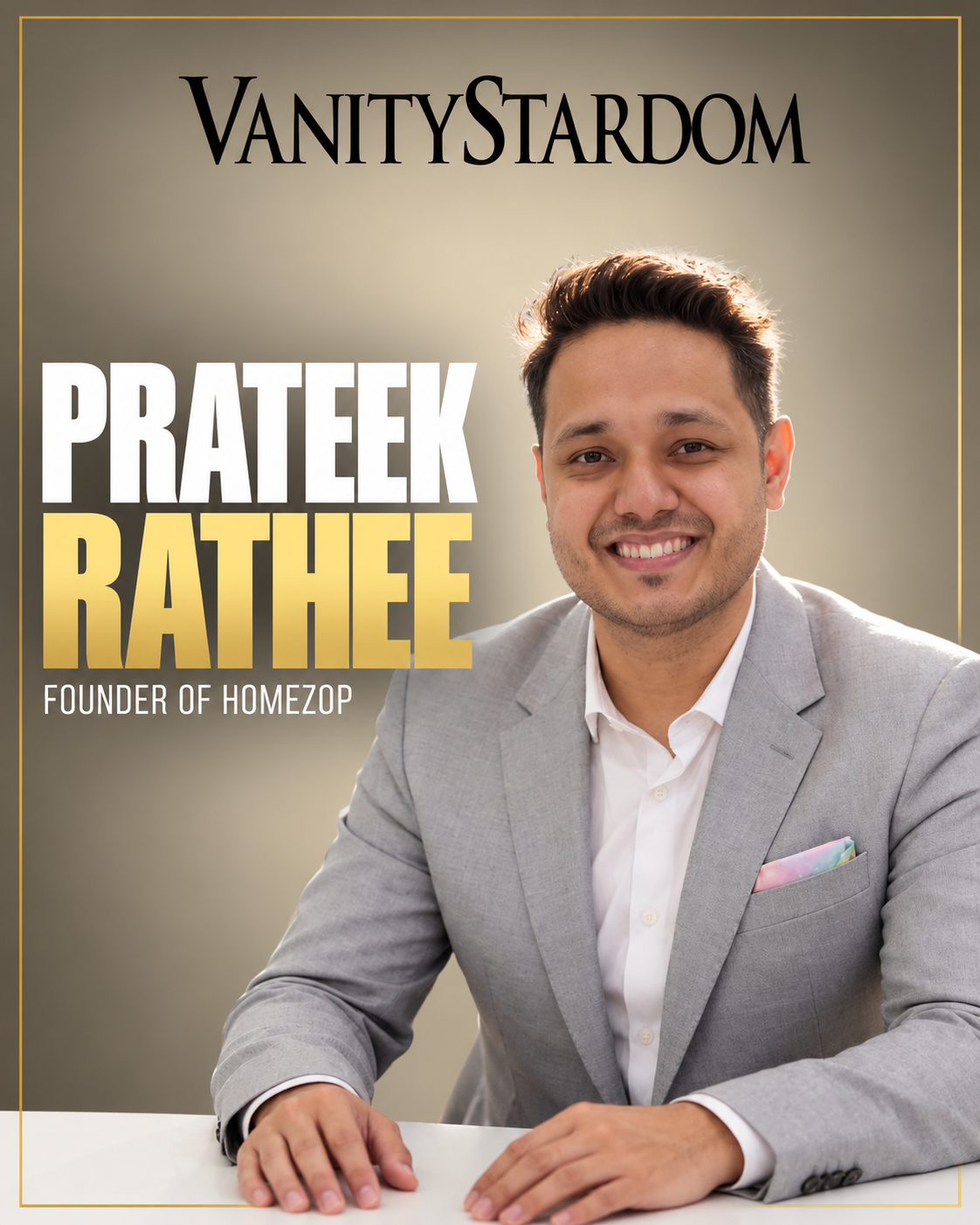
In Gurugram’s rapidly changing real estate landscape, Prateek Rathee has built a career around a simple but increasingly relevant idea: a home should be designed around the way people actually want to live. As the founder and CEO of Homezop, Rathee has taken a route that combines real estate development with a strong digital presence, building both residential projects and a sizeable audience around his experiences as an entrepreneur.
Rathee’s entrepreneurial journey began early. Public profiles describe him as having started working on businesses at around 18, eventually moving into real estate and building Homezop into his principal venture. He studied civil engineering at Amity University, an educational background that has also given him a technical foundation relevant to construction and development.
Homezop’s evolution is particularly notable. The company says it began in 2015 with a small core team and initially operated around interiors before developing into a real estate business focused on residential properties in Delhi-NCR. Its current positioning is centred on modern independent and builder-floor residences, with an emphasis on functionality, design and low-density living.
That transition from interiors to development became one of the defining moves in Rathee’s entrepreneurial career. According to company and business profiles, Homezop has built a substantial residential portfolio in the region, with public company information citing hundreds of residential units delivered across Delhi-NCR. More recent Homezop material describes the business as a boutique developer focused on luxury builder floors in Gurugram.
What differentiates Rathee’s approach is the extent to which he treats real estate as more than a transaction involving square footage. His recent public commentary has increasingly focused on questions such as land share, density, privacy, usable space and long-term ownership value. In one recent discussion, he argued that for certain buyers in prime Gurugram locations, a well-designed four-floor independent residence can offer advantages over a large high-rise—not simply because of the finishes, but because of the underlying land share and lower density.
The argument reflects a broader shift taking place in parts of the premium Gurugram housing market. As buyers become more sophisticated about what they are purchasing, conversations are moving beyond amenities and façade design towards carpet area, land ownership, title clarity, parking, construction quality and long-term usability. Rathee has increasingly made these considerations part of his public communication as well as his business positioning.
Homezop’s own recent material places particular emphasis on independent floors, where fewer residences share the same structure and the relationship between the individual home and the underlying plot becomes more visible. The company describes its current offering around low-density living, privacy and land-linked ownership, while also highlighting the importance of checking documentation and approvals before making a purchase.
His approach to real estate has also been accompanied by a parallel career as a content creator. Rathee has used YouTube and Instagram to document entrepreneurship, real estate, construction, personal experiences and lessons from building businesses. A 2020 video described him as a Gurugram-based entrepreneur and home developer and referenced his interest in sharing experiences accumulated through years of building and scaling businesses.
That creator side has become an important part of his public identity. His Instagram profile currently presents him as an entrepreneur and the founder of Homezop, while also highlighting a substantial YouTube audience. Rather than keeping the business and personal brand completely separate, Rathee has used digital content to make the process of building homes and running a company part of the story itself.
For a real estate entrepreneur, that represents a significant change from the traditional developer model. Real estate has historically been a business where reputation is built through projects, relationships and local networks. Digital platforms now allow founders to build an audience before, during and after a project—giving consumers an opportunity to understand not just what is being sold, but also the thinking behind it.
Rathee’s content often draws from the practical realities of entrepreneurship rather than presenting business as a perfectly linear success story. His social media presence combines property development with personal experiences, family moments and reflections on the journey of building a company. That combination has helped create a more personal connection between the entrepreneur and the audience following his work.
At Homezop, the company’s current positioning also reflects an attempt to make the developer’s philosophy visible in the product. Its public communication increasingly discusses four-floor independent residences, land share, construction quality, documentation and the trade-offs between low-rise homes and high-rise apartments. In doing so, the brand is moving the conversation from simply selling a home towards educating prospective buyers about how to evaluate one.
The scale of that ambition is visible in Homezop’s stated footprint. Company information lists a team spanning corporate and site operations, while earlier business profiles cited a land bank of around 1.25 lakh square feet and more than 150 units delivered. More recent company material claims the number of delivered residential units has crossed 450, reflecting the continued expansion of the business. Because these figures come from different points in the company’s development, they represent different stages of its growth rather than a single contemporaneous measure.
For Rathee, however, the larger story extends beyond the number of homes delivered. His public positioning increasingly centres on building what he describes as a long-term real estate company rather than simply completing individual projects. His LinkedIn profile describes an ambition to build a large real estate company, while his recent commentary focuses heavily on the fundamentals of ownership and the quality of the underlying asset.
This combination of development and digital storytelling has placed Rathee in an interesting position within India’s new-age entrepreneurial landscape. He is not only building physical assets in one of the country’s most competitive residential markets; he is simultaneously building a personal media platform through which the audience can follow the process.
As Gurugram continues to evolve from a corporate hub into one of India’s most important premium residential markets, the choices buyers make are becoming increasingly sophisticated. For entrepreneurs like Prateek Rathee, that creates an opportunity to compete not merely on the size of a property or the appearance of a project, but on a clearer understanding of ownership, design, construction and everyday living.
His journey from an early-stage entrepreneur to the founder of a growing real estate development company illustrates how the modern Indian builder is changing. The business is still ultimately about land, construction and homes—but the way that business is communicated, experienced and understood by consumers is increasingly digital. Rathee’s career sits directly at that intersection, with Homezop representing the physical side of the vision and his creator platform documenting the journey behind it.
